
London: Week 2

Well, well, well. I guess someone has to eat her words.
After saying in last week’s newsletter that I had NO IDEA why Londoners gave out about the Tube when it is this magical, efficient, well-oiled machine, basically implying that the locals were a bunch of soft babies (Silly Billies, I think was the technical term I used), what do you think happened this week? The week when I couldn’t work from home and had to get the Tube in and out of central London every single day?
A strike.
I am, of course, a big fan of unions and strikes. I would follow Mick Lynch into battle, even though he’s probably against that. I would follow him into a very long-standing sit-in, then, whatever he wanted. However, I had the tragic realisation this week that perhaps my socialism only goes so deep, that I am, in fact, a fan of strikes until they inconvenience me personally. The horror! (THAT WAS, HOW YOU SAY, LE JOKE. Do not quote that sentence out of context, I am too tired to get cancelled!!!) Anyway, up the workers, up the unions, up the Tube drivers or whomever else was striking this week. I hope you get your bag/better working conditions.
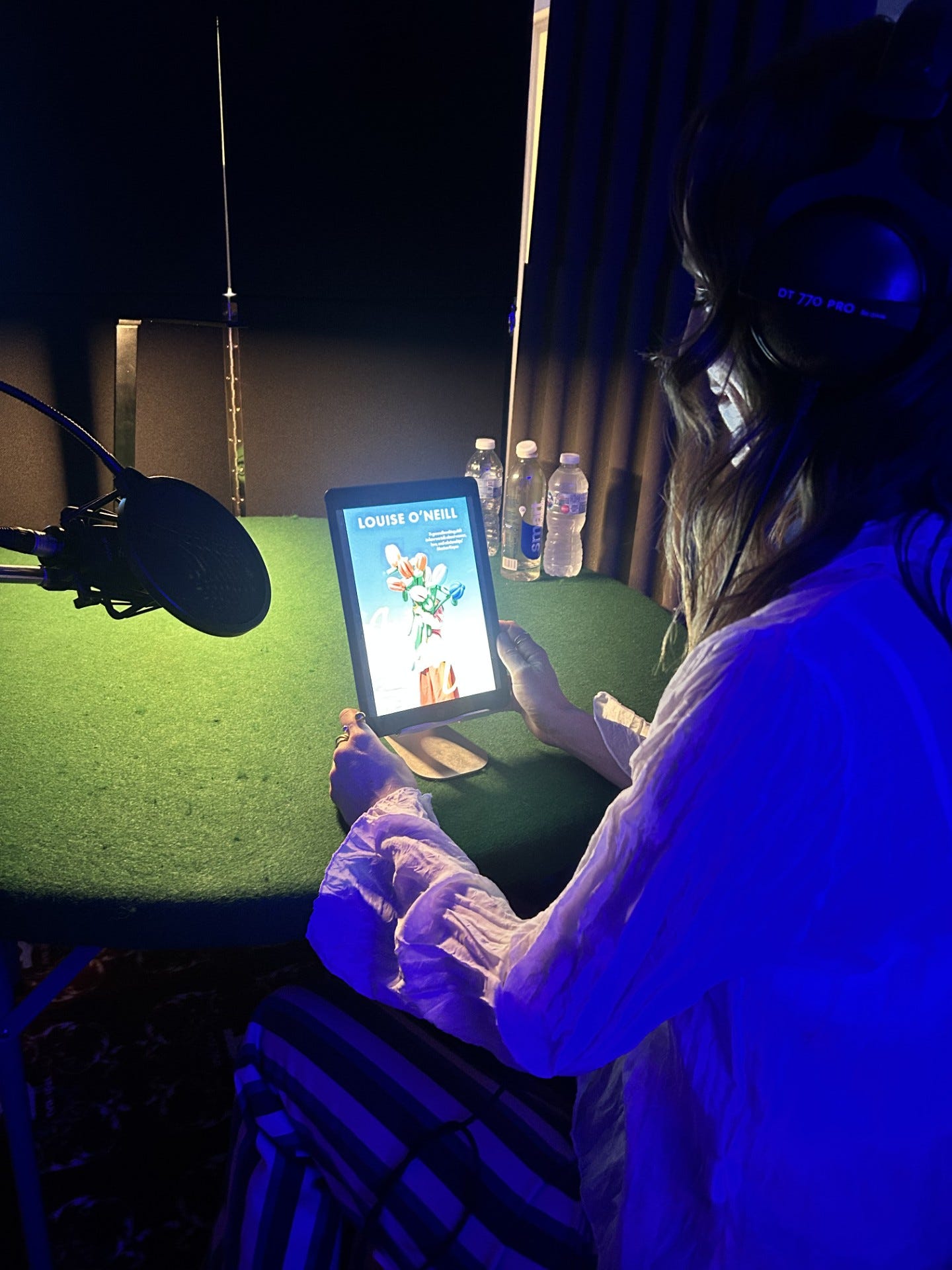
The reason I had to go into central London was because I was recording the audiobook for my memoir, A Bigger Life. (This was the work thing I alluded to in the last newsletter which I thought some of you might find interesting) I have never done the audio for any of my books before. In 2018, I did a blind audition for The Surface Breaks, my feminist re-telling of the Little Mermaid, and was told I came second (and I do have a boyfriend, okay, he just goes to another school) but the “deeper timber” of my voice made it sound too mature for the character. Yes, I was told my voice was too old to play a teenage girl. But when it’s memoir, they prefer the author to read the book – it makes sense, I guess, it’s your story so it should be your voice – so a studio was booked for four days, I stocked up on a lot of honey and lemon, and I got to work. I wanted to be an actor when I was younger so this was a wonderful opportunity for me to ACT, DARLING, but I didn’t anticipate how emotional some of it would be, or how deeply, deeply, embarrassing it would be to read some of the sex scenes. None of them are overly graphic, there’s a lot of cut-to-black action, but having to say “and I moaned” down the microphone made me want to literally die lol.
That’s before we get to the accents. I had said at the beginning that I wasn’t going to attempt the men’s voices, which was all good and grand, but I forget about the place-names in the Paris section. It took about an hour to get through one single page as I fumbled my way through Musée d’Orsay, Officine Universelle Buly in Le Marais, Musée de l’Orangerie, Berthillon on the Île Saint-Louis Canal Saint Martin, the Galerie Vivienne, the Passage des Panoramas, Place de Voges, the Galerie Dior, the Foundation Louis Vuitton and the Palais Galliera. In my defense 1) I didn’t do French for my Leaving Cert and 2) whenever I butchered the pronunciation of a word while I was in Paris, the men I was dating usually said it was adorable and they loved my accent.
It occurs to me now that they may have been lying.
Anyway, audio is obviously a huge market now and I really wanted to do the book justice. If you do decide to listen rather than read, please lie like the French men and tell me I’m adorable, okay? (It is available for pre-order here)
Other than that, I have slightly overbooked myself for June. I joined an accountability group with three other writers I respect enormously, pledging that we would write between 1-2k words a day for the month of June to get our new books off the ground. At the same time, I spotted that the Pilates studio near where I’m staying is doing a month long offer for unlimited classes so I committed to doing a ballet barre/Pilates class a day. If you’re wondering what that looked like, it involved waking at 6am and writing until 7.30, going to class from 7.30-8.15, then writing for another hour before going to the studio to record the audiobook from 11am-6pm. Why am I like this? WHY? And I couldn’t skip any of the writing because I am pathetically susceptible to peer pressure and didn’t want to be the only one in the Group Chat with nothing to show for it at the end of the day lol. Je suis tired.
Also, because I am contemplating moving to London full time and am very much trying to create a community here, I’m saying yes to every invitation that comes my way. I went to a birthday picnic in Battersea Park for one of my favourite people in the city. I went to a book launch*. I went to Brunch Book Club . I had a dinner date and a tea date and another dinner/comedy gig date. I won’t complain because I do love making friends, the joy of meeting new people and finding out their entire life story because I am such a CURIOUS person, you know, it’s all part of being an ARTIST of course. (Yes, fine, I am nosy as fuck)
Finally, the two cultural things I did this week were:
1) I went to the all-female production of Glengarry Glen Ross at the Old Vic. I am not sure if I am best placed to write a review of this. It was after the last day of recording the audiobook and I was so tired, I almost fell asleep in my seat. The acting was superb – I am obsessed with Indira Varma! – but it all felt very “big.” I wondered afterwards if I just didn’t vibe with the play itself? If you’ve seen another production of this, please sound off in the comments. I’d love to know.
2) I went to Old Chapel, a gorgeous church in Islington, to see the comedians David O’Doherty, Bridget Christie, Hasan Al-Habib, and others. Beautiful venue, very funny people on stage. What’s not to love?
That’s it from me this week. As always, if you have any suggestions for things to do/see/eat, TELL ME IMMEDATELY. xxx
*It was a joint launch for Daisy Buchanan and Rosie Walsh’s new books. I haven’t read Rosie’s yet but it looks brilliant. I have read Daisy’s and I loved it. All Grown Up is a modern day retelling of Little Women, and it is so charming and funny and moving. V much recommend.
https://www.amazon.co.uk/Foundling-Girls-Chapel-Write-Publications-ebook/dp/B0GZFFVSQ2
A Galway author, Mary Rose Tobin, has just published her debut novel inspired by the Foundling Museum. I’ll let her tell you about it herself…
’I was visiting the Foundling Museum in Brunswick Square — you may know it — and I turned a corner and there they were. A group of girls in brown serge uniforms with white aprons, standing in a chapel, hands clasped in prayer. The painter was a French-born artist called Sophie Gengembre Anderson, and she had painted them in the 1870s. Real children. Real faces. The painting is called Foundling Girls in the Chapel.
I stood in front of it for quite a long time. And I found myself asking a question I couldn’t answer. Who were you? What became of you?
Nobody knew. The records of the Foundling Hospital tell you a child’s name, a token left by the mother — a scrap of lace, a bent coin, a mother-of-pearl button — and a date of admission. They don’t tell you what it felt like to be five years old and separated from the only mother you know. They don’t tell you what it meant to grow up in a place that raised you for usefulness rather than happiness. And they certainly don’t tell you what happened afterwards.
That question — What became of you? — is where this novel began.
And then there is Handel. George Frideric Handel supported the Foundling Hospital through annual benefit performances of his Messiah. He conducted it in that chapel. And those children — some of them too young to understand the words — sang it. They stood in the chapel where my girls stand in the painting, and they sang about redemption, about God’s love for the forsaken.
When I discovered that, I actually gasped. Because I’ve sung Messiah myself, many times. I know that music in my bones. And the thought of those children singing I Know That My Redeemer Liveth when their own redeemer had left them at a hospital gate — was almost too much to hold.
Lucy is my protagonist. She is nine years old when we meet her, one of fifty girls in a narrow dormitory that smells of damp wool. When Sophie Anderson arrives to paint the girls in the chapel, it is the first time anyone has looked at Lucy and seen something worth keeping. That moment — of being genuinely seen — is what the whole novel is about.
I’m not going to tell you how it ends. You’ll have to read it for that.’
But do go and visit the Foundling Museum - you won’t be disappointed.